
How Do I Stop Saying Yes to Things and Start Getting My Energy Back
If you find yourself saying yes to things you don’t really want to do, you’re not alone. This post explores why it can feel so hard to stop especially when guilt and fear of disappointing others show up and offers a few gentle starting points to help you begin choosing what feels right for you.
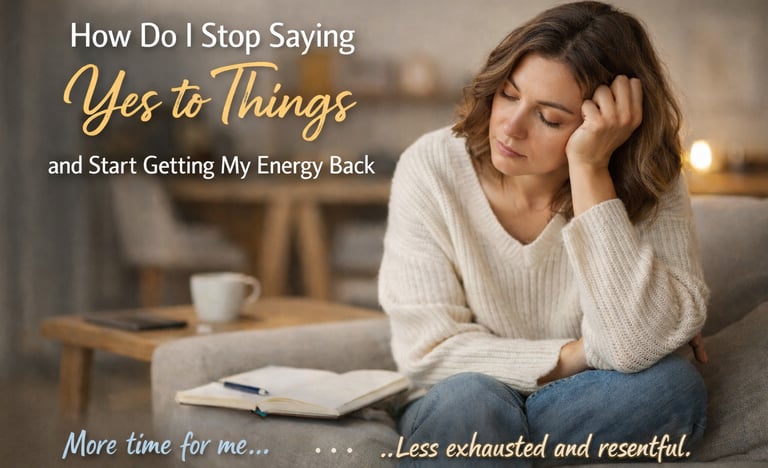

How Do I Stop Saying Yes to Things and Start Getting my Energy Back
There’s a particular kind of exhaustion that comes from being the reliable one.
The one who says yes.
The one who steps in.
The one people can count on, always.
On the surface, it can look like kindness or generosity. But underneath, it often feels quite different. You might notice a quiet resentment building, or a sense that there’s never quite enough time for yourself. And still, when the next request comes in, you hear yourself saying yes again.
If you’ve ever found yourself thinking, “Why do I always say yes to things when I don’t actually want to?” this is for you.
Why do I always say yes, even when I don’t want to?
It’s rarely because you don’t know how to say no.
Most people I work with do know how to say it. They have just learnt, over time, that saying no comes with a cost.
That cost is usually emotional.
Guilt.
Discomfort.
Worry about how you’ll be seen.
A fear that you’ve let someone down, or worse, that you are someone who lets people down.
So the yes becomes a way of avoiding that feeling.
Not because you don’t have boundaries but because the moment after the boundary feels too uncomfortable to sit with.
It’s not the “no” that’s hard, it’s what comes after
This is the part that often gets missed.
A lot of advice focuses on how to say no. Scripts, wording, techniques.
But for many people that is not actually where things fall apart.
It is what happens afterwards.
You might say no and then immediately question yourself.
You replay the conversation.
You wonder if you sounded harsh.
You feel a pull to go back and soften it, explain more or even change your answer entirely.
So the next time, it feels easier to just say yes in the first place.
Not because it is what you want but because it avoids that spiral.
How do I stop saying yes to things?
Rather than focusing on saying the perfect no, it can be more helpful to shift your attention slightly.
Here are a couple of starting points.
1. Start noticing the moment before you say yes
For many people, the yes happens quickly almost automatically.
Before you have had a chance to check in with yourself.
So the first step is not to change your answer. It is simply to pause.
Even a small pause creates space.
You might say:
“Let me check and get back to you”
“I’m not sure yet, can I come back to you later?”
This is not about avoidance. It is about giving yourself enough time to notice what you actually feel rather than defaulting to what is expected.
2. Expect the guilt and plan for it
If guilt is what keeps you stuck, it helps to stop treating it as a sign you have done something wrong.
Instead, you might begin to see it as something that shows up because you are doing something different.
The aim is not to get rid of the guilt.
It is to learn that you can tolerate it.
That it can be there, uncomfortable, persistent, even loud and you do not have to act on it (this is something we explore a lot in therapy and try different ways of tolerating the guilt/discomfort).
This is often where the real shift happens.
Not in the words you use but in your relationship with that feeling afterwards.
“What if people think I’m a bad person?”
This is one of the most common worries.
That saying no will change how people see you.
That they will be disappointed, frustrated or pull away.
And sometimes, people will notice the change.
But it is worth asking:
Are the relationships in your life built on you always saying yes?
Or is there space for you to be a full person, with limits, needs and boundaries?
Learning to step out of constant yes does not mean becoming uncaring or unavailable.
It means becoming more honest about what you can offer and what you cannot.
A different way of thinking about it
If you have been the reliable one for a long time, saying yes can feel like part of who you are.
So changing it is not just about behaviour. It can feel like changing your identity.
You might consider this:
You are not trying to become someone who says no all the time.
You are learning to become someone who chooses.
Someone who can say yes when they mean it and no when they need to without immediately undoing that decision.
A gentle place to start
You do not have to overhaul everything at once.
You might begin with one small moment this week:
pausing before you answer
noticing the pull to say yes
or sitting with the discomfort of a no, even briefly
It is not about getting it right every time but about beginning to notice what is happening.
If this is leaving you feeling exhausted…
If you are constantly saying yes and ending up with no time or energy for yourself, that is something worth paying attention to.
This is not just about being better at boundaries.
It is often about understanding where this pattern came from and why it feels so difficult to change even when part of you really wants to.
If that is something you would like to explore you are very welcome to get in touch here and see if working together feels like a good fit.
And if guilt is a big part of this for you, you might also find this other blog helpful. Click here
Common Questions
Why do I always say yes to things even when I’m overwhelmed?
Often, it is not about capacity. It is about what saying no brings up emotionally. If saying no leads to guilt, worry or fear of disappointing others, it can feel easier to say yes in the moment, even if it costs you later.
How do I stop feeling guilty when I say no?
Rather than trying to eliminate guilt, it can help to learn how to tolerate it. Guilt does not necessarily mean you have done something wrong. Sometimes it is a sign you are doing something different.
Will people be upset if I stop saying yes all the time?
Some people might notice a change, especially if they are used to you always agreeing. But healthy relationships can adjust. Over time, being more consistent and honest often leads to more balanced connections.
Is it selfish to start saying no more often?
It can feel that way especially if you are used to prioritising others. But having limits does not make you selfish. It allows you to show up in a way that is more sustainable and genuine.
Can therapy help with people-pleasing?
Yes, therapy can help you understand where the pattern comes from and support you in building a different relationship with guilt, boundaries and your own needs.
Contact
© 2025. All rights reserved.


Lisa Ume
Qualified and accredited therapist providing online therapy for women focused on self worth, people pleasing and emotional overwhelm.
What Are you Looking For?
Resources
@lisaumetherapy on instagram. Click this icon to take you there. Alternatively you can see a preview of my feed here